
How to Write Multi Perspective Stories – A Complete Guide to Powerful POV Narratives
How to write multi perspective stories is a question that many writers struggle with when they want to create complex, engaging, and realistic narratives. Writing from multiple viewpoints helps readers connect with each character deeply — but if done wrong, it can confuse readers, weaken emotional impact, and break the flow of the story.
Today’s audience expects depth, dynamic scenes, and layered storytelling. They don’t just want one truth — they want many perspectives. This blog post will teach you exactly how to write multi perspective stories that are clear, engaging, emotionally powerful, and professionally structured.
Let’s dive into the storytelling techniques that publishers love, readers enjoy, and writers can master with practice.
How to Write Multi Perspective Stories
How to write multi perspective stories starts with understanding how characters view the world differently — and how your writing can reveal those differences without confusing your readers.
Multi POV storytelling is not just a writing technique. It’s a narrative strategy that gives your story depth, tension, and realism.
Why Use Multiple Perspectives in Storytelling?
Readers crave immersion. They want access to different minds, motives, and hidden emotions. Multi perspective storytelling gives them exactly that.
Key Benefits of Multi POV Writing
- Stronger emotional connection – readers relate to different characters.
- Deeper world-building – more viewpoints mean more information.
- Natural suspense & tension – readers know more than the characters know.
- Complex narrative viewpoint guide – explores themes from various angles.
But there’s a catch:
Without structure, multi POV writing becomes chaotic. That’s why the methods below matter.
Core Principles – How to Write Multi Perspective Stories Effectively
Rule #1 – Each POV Must Add Something Unique
Don’t use multiple perspectives just for style.
Each character viewpoint must:
- Reveal new information
- Show hidden emotions
- Move the story forward
If a perspective doesn’t change something… it doesn’t belong in your story.
Rule #2 – Establish POV Boundaries Clearly
Readers must instantly know whose mind they are inside.
Best practices for POV clarity:
| Technique | Usage |
| Chapter titles | “Chapter 4 – Sarah” |
| Tone change | More aggressive/soft depending on character |
| Dialect & language shifts | Word choice reflects personality |
| POV transitions writing tips | Use scene breaks for perspective shifts |
Avoid confusion at all costs.
Rule #3 – Avoid Head-Hopping
Head-hopping is when the POV suddenly jumps to another character within the same paragraph or scene. This breaks immersion.
Bad example:
John was nervous. Sarah wondered why he was so quiet.
Here, we jumped into two minds instantly.
Good example:
John’s hands shook as he reached for the cup.
Across the table, Sarah studied him with quiet curiosity.
One POV at a time.
Techniques for Writing from Multiple Viewpoints
Character-Driven Perspective Shifts
Each character’s viewpoint should be shaped by:
- Their beliefs
- Their fears
- Their past
- Their goals
Ask this before shifting POV:
What does this character know… that others don’t?
Writing from Multiple Viewpoints – Styles
| POV Style | Suitable For |
| First-person rotating POV | Emotional depth & realism |
| Third-person limited multi POV | Mystery or action stories |
| Omniscient narrator | Complex novels with large casts |
| Epistolary format (letters/diaries) | Historical or memoir-style stories |
POV Transitions Writing Tips
Use these signals when switching perspectives:
- Chapter breaks
- Time jumps
- Location changes
- Internal monologue opening
Tip: Let each POV carry a theme.
Example:
– Sarah’s POV explores love
– Mark’s POV explores guilt
– Emily’s POV explores justice
This creates emotional structure within the story.
Real-World Examples of Multi Perspective Storytelling

1. “Gone Girl” by Gillian Flynn
Uses dual POVs to create mistrust and suspense between characters.
2. “Game of Thrones” by George R.R. Martin
Each chapter follows a different character, building a massive world through shifting lenses.
3. “The Night Circus” by Erin Morgenstern
Switches POVs based on time and character motives to unfold a layered romantic mystery.
Step-by-Step Guide – How to Structure Multi POV Stories
Step 1 – Define Each Character’s Purpose
Each character should answer a narrative question:
- What truth can they reveal?
- What secret do they hide?
- What change will they experience?
Step 2 – Build a POV Chart
| Character | Role | POV Style | Hidden Truth |
| Sarah | Protagonist | 1st Person | Fear of failure |
| Michael | Mentor | 3rd Person | Secret past |
| Laura | Antagonist | 3rd Person | Revenge motive |
This visual clarity helps prevent confusion while writing.
Step 3 – Create POV Rules
- No more than 3 POVs per story (beginner-friendly)
- Each POV must have a unique goal
- End chapters with emotional or narrative cliffhangers
Step 4 – Master Voice & Tone
Each character’s voice should be recognizable without their name mentioned.
Test:
Remove the character’s name. Can you still tell who is speaking?
Step 5 – Revise & Strengthen Perspective
During editing, check:
- Is each POV necessary?
- Does it move the story forward?
- Does every POV increase tension, mystery, or emotion?
If not — cut it.
Comparison – Single POV vs. Multi POV Writing
| Feature | Single Perspective | Multi Perspective |
| Emotional depth | Moderate | High |
| Reader immersion | Limited | Dynamic |
| Writing difficulty | Easy | Complex |
| Character insights | One-sided | Multi-layered |
| Useful for mystery? | No | Yes |
| Suitable for beginners? | Yes | With guidance |
Common Mistakes to Avoid in Multi POV Writing
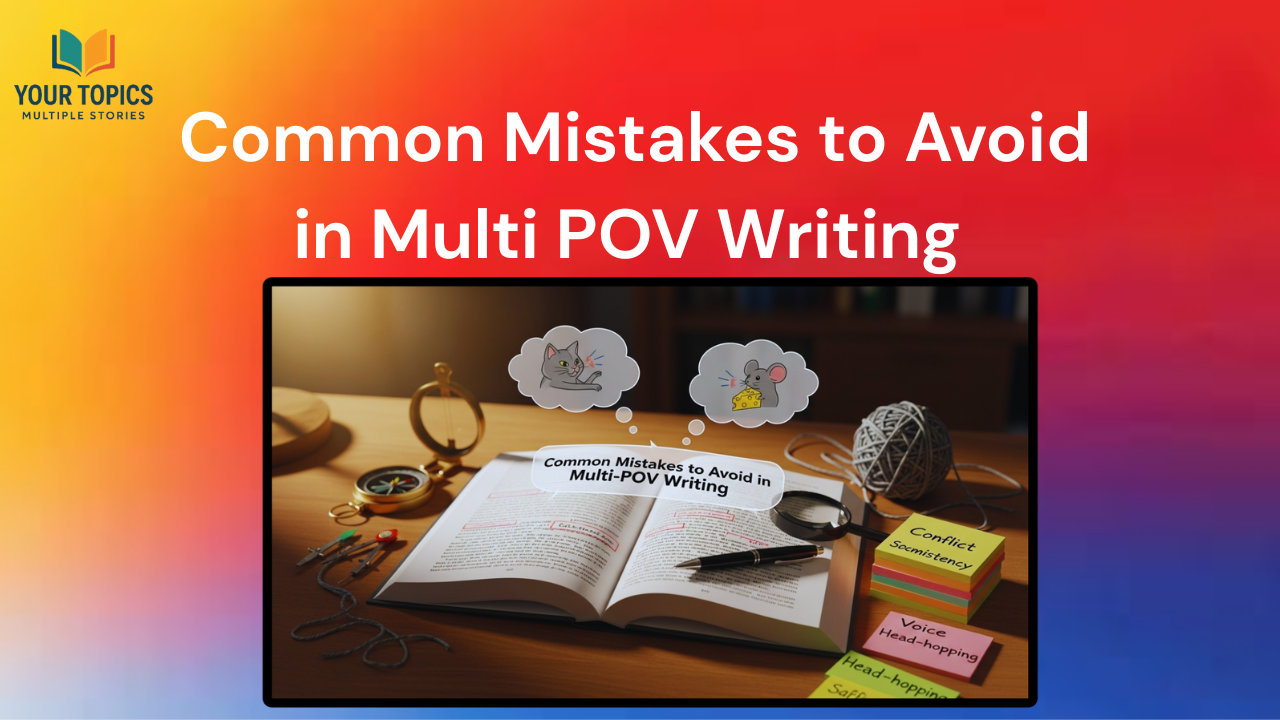
- Random switching of perspectives
- Too many characters too fast
- Overlapping information
- Repeating the same scene from different POVs
- Losing character voice consistency
Fix: Always ask — Is this POV critical? Does it help the reader understand something new?
FAQs – Based on Google Searches
How many POV characters should I use?
For beginners, 2–3 characters are ideal. More than 5 can become confusing without strong structure.
Can I write flashbacks in multi POV stories?
Yes — but make sure the flashback relates to the character’s inner conflict or motivation.
How do I make each character sound unique?
Use different sentence styles, vocabulary, emotional tone, and pacing.
What POV is best for mystery and suspense?
Third-person limited with multi perspectives works best. It lets readers know more than the characters.
Final Thoughts – Your Story Has Many Voices
Learning how to write multi perspective stories is about more than switching characters — it’s about understanding how humans think, feel, remember, and change.
When done correctly, this storytelling method:
- Builds emotional tension
- Engages readers deeply
- Reveals hidden truths
- Creates unforgettable narratives
Your goal isn’t to show many characters — but to reveal many truths.
If every perspective adds value, your story will not only be readable —
it will be unforgettable.
Want more storytelling techniques, character-building guides, and narrative strategies?
Explore more at yourtopicsmultiplestoriess.com — where stories become experiences.