
Time Management Skills: The Complete Guide to Reclaiming Your Day and Boosting Productivity
Time management skills have become the difference between professionals who thrive and those who barely survive the workday. You know the feeling—it’s 6 PM, your to-do list looks exactly like it did at 9 AM, and you’ve somehow been “busy” for nine straight hours without accomplishing your main priorities.
Sound familiar? You’re not alone. Most people struggle with managing their time not because they lack motivation, but because they’ve never been taught the practical systems that actually work.
Why Most People Fail at Time Management (And How You Can Succeed)
The traditional approach to time management is broken. We’ve been told to “work harder,” “wake up earlier,” or “just focus better”—advice that ignores the real problem. The issue isn’t your work ethic. It’s that you’re trying to manage time itself, which is impossible.
What you can manage is your attention, energy, and priorities. Once you understand this fundamental shift, everything changes.
The professionals who master time management don’t have more hours in their day. They’ve simply learned to protect their focus, eliminate decision fatigue, and structure their days around their natural energy patterns. These are learnable skills, and this guide will show you exactly how to develop them.
The Foundation: Understanding What Time Management Really Means
Before diving into tactics, let’s clear up a common misconception. Time management skills aren’t about cramming more tasks into your schedule. They’re about making intentional choices about where your attention goes.
Think of your daily attention as a budget. You have a fixed amount, and every notification, meeting, and interruption makes a withdrawal. Poor time managers operate with an overdraft—constantly switching between tasks, never achieving deep work, and ending the day mentally exhausted with little to show for it.
Effective time managers, on the other hand, spend their attention budget deliberately. They know which tasks deserve prime cognitive hours and which can happen during lower-energy periods.
Core Time Management Skills Every Professional Needs
Priority Identification and Ruthless Elimination
The first skill separates the genuinely important from the merely urgent. Many people confuse motion with progress, staying busy with low-value tasks while critical projects languish.
Here’s a practical framework that works: Each morning, identify your “non-negotiable three”—the three outcomes that would make today successful, regardless of what else happens. These aren’t just tasks; they’re results that move your biggest goals forward.
Everything else becomes secondary. This doesn’t mean you ignore other responsibilities, but you protect time for your top three before anything else touches your calendar. When someone requests your time, measure it against these priorities. Does this meeting serve your non-negotiable three? If not, can it be an email instead?
Strategic Planning vs. Reactive Scrambling
Most professionals operate in constant reaction mode—checking email first thing in the morning and letting other people’s priorities dictate their entire day. This approach guarantees you’ll never make meaningful progress on your own goals.
The alternative requires just fifteen minutes of daily planning, but it transforms everything. The best time is the evening before, when you can think clearly about tomorrow without the pressure of an active workday.
During this planning session, review your calendar, block time for your non-negotiable three, and identify potential obstacles. When will you be most alert? Schedule complex thinking work for those windows. When are you typically less focused? That’s when you batch administrative tasks like email and expense reports.
This practice of daily planning gives you something precious: control. You start each day with intention rather than anxiety.
Focus Protection and Deep Work Creation
Your ability to focus deeply for extended periods is perhaps the most valuable time management skill in today’s distraction-filled environment. Unfortunately, it’s also the rarest.
Research shows that after an interruption, it takes an average of 23 minutes to return to full concentration on a task. If you’re getting interrupted every 10-15 minutes, you never actually reach deep focus. You’re perpetually operating in a state of partial attention.
The solution involves creating protected time blocks—periods where you’re genuinely unavailable for interruptions. Start with just 90 minutes, three times per week. Close your email, silence notifications, put your phone in another room, and work on a single complex task.
This might feel uncomfortable initially. We’ve become addicted to the dopamine hits from notifications and the false sense of productivity from constant task-switching. Push through that discomfort. The quality of work you produce during protected focus time will astound you.
Productivity Tips That Actually Work in Real Life
The Two-Minute Rule (With a Twist)
You’ve probably heard the basic version: if something takes less than two minutes, do it immediately. But here’s the refinement that makes this productivity tip actually useful—apply it only during designated administrative windows, not during deep work time.
Set aside two or three specific periods each day for quick tasks and emails. During these windows, apply the two-minute rule aggressively. Outside these windows, capture quick tasks in a running list for later.
Time Blocking for Different Energy Levels
Your energy fluctuates throughout the day in predictable patterns. Most people experience peak cognitive performance 2-4 hours after waking. There’s typically another, smaller peak in the late afternoon, and a significant dip after lunch.
Manage time effectively by aligning task difficulty with your energy levels. Schedule your most challenging work—strategic thinking, complex problem-solving, creative work—during peak energy windows. Save routine tasks, meetings, and administrative work for lower-energy periods.
This approach to daily planning multiplies your effectiveness because you’re working with your natural rhythms rather than against them.
The Power of the Weekly Review
Daily planning handles the immediate, but weekly reviews create the strategic context that makes daily decisions easier. Set aside one hour each week—Sunday evening or Friday afternoon works well—for a comprehensive review.
During this session, assess what worked and what didn’t in the past week. Review your calendar for the coming week and identify potential conflicts or overcommitments. Most importantly, ensure your daily non-negotiable threes for the coming week actually ladder up to your bigger quarterly and annual goals.
Work-Life Balance: Integration, Not Separation
The phrase “work-life balance” suggests these are opposing forces competing for your time. A more useful frame is work-life integration—designing a life where professional and personal priorities complement rather than conflict with each other.
This starts with defining your non-work non-negotiables. What three to five things outside of work are essential for your wellbeing and happiness? For many people, this includes physical exercise, quality time with family, adequate sleep, and at least one hobby or creative outlet.
Once you’ve identified these, protect them with the same intensity you protect your most important work priorities. They’re not rewards you earn after working hard enough—they’re the foundation that makes sustained high performance possible.
Common Time Management Mistakes and How to Avoid Them
The Multitasking Myth
Despite overwhelming research showing that multitasking reduces productivity and increases errors, many professionals still pride themselves on juggling multiple tasks simultaneously. What they’re actually doing is task-switching—rapidly shifting attention between different activities.
This approach devastates your focus improvement efforts. Each switch carries a cognitive cost. Your brain needs time to reorient to a new context, and during that transition, you’re not working effectively on either task.
The solution is single-tasking: one priority, one block of time, full attention. This feels slower initially, but you’ll complete higher-quality work in significantly less total time.
Confusing Presence with Productivity
Many workplace cultures equate visibility with value—being the first to arrive, last to leave, and quickest to respond to emails. This mindset leads to chronic overwork without corresponding results.
Real productivity comes from outcomes, not hours logged. A professional who accomplishes their key objectives in six focused hours is infinitely more valuable than one who stays busy for ten hours while achieving little of substance.
Manage time effectively by measuring yourself on results delivered, not time spent appearing busy. This shift liberates you to work in the way that actually produces your best work.
Saying Yes to Everything
Poor time management often stems from an inability to decline requests. You want to be helpful, collaborative, and responsive. But saying yes to everything means saying no to your own priorities.
Learning to decline gracefully is a critical time management skill. The key is offering alternatives: “I can’t take that on this week, but I could help you next Tuesday,” or “I’m not the best person for this, but have you asked Sarah in operations?”
Time Management Skills Comparison: Traditional vs. Modern Approaches
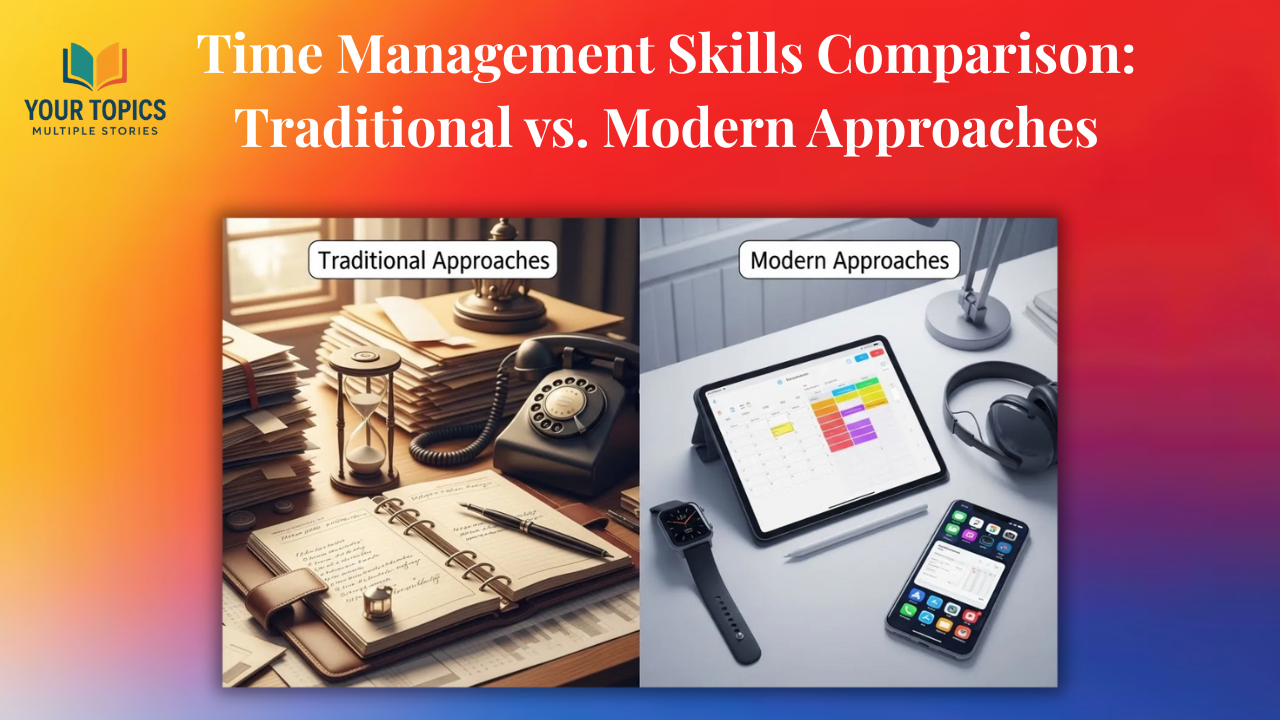
| Traditional Approach | Modern Approach |
| Focus on doing more tasks | Focus on doing the right tasks |
| Constant availability | Protected focus time |
| Equal weight to all tasks | Ruthless prioritization |
| React to incoming demands | Proactive daily planning |
| Measure hours worked | Measure outcomes achieved |
| Separate work and life | Integrate work and life |
| Multitask everything | Single-task with intention |
The traditional approach keeps you perpetually busy but rarely satisfied. The modern approach feels counterintuitive initially—doing less, protecting time, declining requests—but delivers exponentially better results.
Frequently Asked Questions About Time Management
How long does it take to develop strong time management skills?
Most people notice significant improvements within three to four weeks of consistent practice. The key is implementing one new habit at a time rather than overhauling your entire system at once. Start with daily planning for two weeks, then add protected focus blocks, then incorporate weekly reviews.
What’s the best time management technique for people with unpredictable schedules?
When your schedule is inherently chaotic, focus on the controllable elements. Even if you can’t control when interruptions happen, you can control your priorities and how you respond.
Keep your non-negotiable three always visible, and return to them whenever you have open blocks of time. Use a “capture system”—a single place to note incoming tasks and requests—so you’re not trying to remember everything mentally.
How can I improve my focus when I work from home with constant distractions?
Working from home requires stronger boundaries, not weaker ones. Create a designated workspace that signals “work mode” to your brain and others in your household. Establish specific hours when you’re unavailable for non-emergency interruptions.
Use visual cues—a closed door, headphones, a specific signal—to communicate when you’re in deep work mode. The clarity of these boundaries makes them easier for everyone to respect.
Should I use time management apps and tools?
Tools can help, but they’re not magic solutions. The best system is the one you’ll actually use consistently. Many professionals find that a simple paper planner or digital calendar plus a running task list covers 90% of their needs. Add specialized tools only when you’ve identified a specific gap in your current system.
How do I balance time management with being flexible and spontaneous?
Strong time management skills actually create more freedom, not less. When you’ve protected time for your most important work, you can be genuinely present and flexible during the rest of your day without guilt or stress. The goal isn’t to schedule every minute—it’s to ensure your true priorities never get lost in the chaos.
Taking Action: Your First Week of Better Time Management
Reading about time management skills won’t change anything. Implementation will. Here’s your starter plan for the first week:
Days 1-2: Observe your current patterns without trying to change them. Track where your time actually goes. Most people are shocked by how much time disappears to email, meetings, and interruptions.
Days 3-4: Identify your non-negotiable three for each day. Don’t worry about protecting time for them yet—just practice the skill of identifying what truly matters.
Days 5-7: Add one 90-minute protected focus block to your calendar. Guard it fiercely. Experience what deep work feels like without interruptions.
This gradual approach works because you’re building habits sequentially rather than attempting a dramatic overnight transformation that rarely sticks.
The Long Game: Sustaining Your Progress

Time management isn’t a problem you solve once. It’s a practice you maintain. Your priorities will shift, new challenges will emerge, and you’ll occasionally fall back into old patterns. That’s normal.
The difference between someone with strong time management skills and someone without them isn’t perfection—it’s resilience. When you notice yourself drifting back into reactive mode or losing focus, you have the tools to course-correct quickly.
Set a monthly reminder to assess what’s working and what needs adjustment. Your time management system should evolve with your responsibilities and goals. What works during a project-heavy season might need modification during a slower period.
Remember, the ultimate goal isn’t productivity for its own sake. It’s creating space for the work that matters, the relationships that enrich you, and the life you actually want to live. Time management skills are simply the vehicle that gets you there.
Your days are the building blocks of your life. Managing them well isn’t about squeezing in more tasks—it’s about making sure that when you look back, you’ve spent your finite time on things that truly mattered.