The Psychology of Waiting: Why Queue Experience Impacts Customer Satisfaction
Most businesses believe customer satisfaction begins when a customer reaches a checkout counter or receives a service.
In reality, customer satisfaction starts much earlier. It starts the moment a customer enters a queue.
Whether someone is waiting in a hospital, bank, government office, retail store, airport, or event venue, their perception of the business begins forming during the waiting process. Before they purchase anything, receive assistance, or any transaction occurs, they are already evaluating the experience.
This is where many organisations go wrong. They are concerned with speeding up services and ignoring the psychology of waiting.
The fact is, people don’t assess waiting times just in terms of minutes. They assess it based on their own feelings when waiting.
By understanding the psychology of waiting, businesses can better meet the expectations of their customers, boost loyalty, and enhance the overall experience without necessarily adding more employees or increasing expenses.
Let’s discover in the following blog how long queues influence visitor experience and how a simple queue management system maximizes customer satisfaction.
Why Waiting Feels So Personal
Every second spent in line is a chance to build up positive or negative perceptions.
Customers start asking questions like:
- Why is this taking so long?
- Do they value my time here?
- Does it make sense to wait for such a service?
- Then, will I return in the future?
These questions are emotional rather than rational in nature, and their answers are often emotional.
The Hidden Business Cost of Poor Queue Experiences
Poor waiting experiences can be harmful — many organisations underestimate.
Long or poorly managed queues have a wider impact than just on customer mood. They can affect business performance.
Businesses can have the following effects when customers get frustrated while waiting:
- Higher customer abandonment rates
- Lower customer retention
- Increased complaints
- Negative online reviews
- Reduced employee morale
- Lost revenue opportunities
Very rarely does a customer walk away due to a poor queue experience; they simply don’t tell the business. Rather, they just pick another competitor the next time.
Psychology Principle #1: Unoccupied Time Feels Longer Than Occupied Time
Ever wonder why 5 minutes in a checkout line feels like 5 minutes of scrolling through your phone?
This is because the human brain focuses more on time when there is no other activity to focus on. Idle waiting amplifies awareness of every passing minute.
This principle explains why airport security lines often feel shorter when passengers can see progress and activity. It also explains why waiting rooms with nothing to do tend to generate more complaints.
The lesson for businesses is clear.
Customers should never feel mentally idle while waiting.
How Businesses Can Apply This Principle
Leading organizations keep customers engaged by providing:
- Digital information displays
- Interactive kiosks
- Mobile notifications
- Educational content
- Service updates
- Promotional messaging
- Self-service options
The goal is not to distract customers. The aim is to keep time productive when waiting.
Satisfaction rises if customers perceive their time being used well, even if the wait is the same.
Psychology Principle #2: Uncertain Waits Feel Longer Than Known Waits
Imagine being told:
“It will take about 15 minutes till your turn.”
Now compare that to hearing nothing at all.
In most cases, customers prefer certainty—even if the wait is longer.
Uncertainty creates anxiety.
When customers do not know how long they will wait, they often assume the worst. Every passing minute feels longer because there is no clear endpoint.
This psychological response is why transparency has become one of the most powerful tools in customer experience management.
Why Visibility Matters
Customers feel more comfortable when they know:
- Their position in line
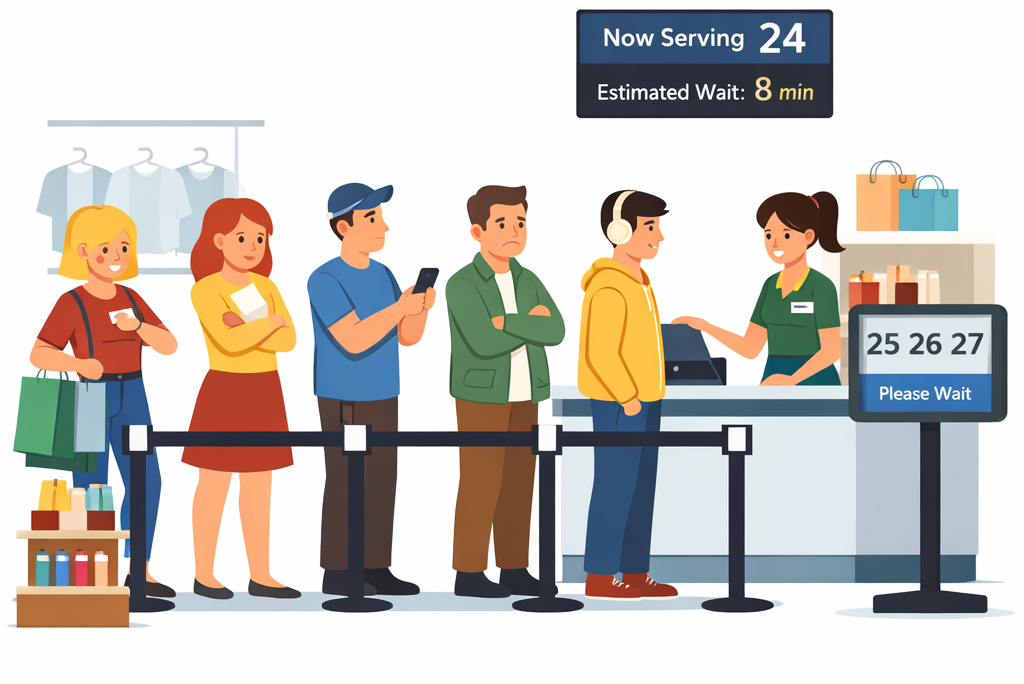
- Estimated waiting time
- Service progress
- Expected next steps
Even when delays occur, customers tend to be more forgiving if they understand what is happening.
Communication reduces frustration because it removes uncertainty.
Psychology Principle #3: Perceived Fairness Matters More Than Speed
One of the fastest ways to create customer frustration is to make the process appear unfair.
People are naturally sensitive to fairness.
Even if a queue moves quickly, customers become dissatisfied when they believe others are receiving preferential treatment without explanation.
Examples include:
- Customers are being served out of order
- Confusing priority systems
- Lack of transparency about service rules
- Inconsistent handling of appointments
The emotional reaction to perceived unfairness is often stronger than the reaction to waiting itself.
Customers may tolerate delays.
They rarely tolerate feeling ignored.
Building Trust Through Fair Processes
Businesses can improve perceived fairness by:
- Using clear queue structures
- Communicating priority rules
- Providing visible service order updates
- Creating transparent queuing management system
- Ensuring consistency across service channels
When customers understand the process, they are more likely to trust it.
Trust reduces frustration.
Psychology Principle #4: Waiting Before Service Feels Longer Than Waiting During Service
Interestingly, customers perceive waiting differently once service begins.
A person waiting twenty minutes before speaking with an advisor may become frustrated.
That same person may happily spend twenty minutes discussing solutions once the interaction starts.
The reason is simple.
Waiting feels passive.
Receiving service feels productive.
Once customers feel progress is being made, their focus shifts away from the passage of time.
How Businesses Can Reduce Pre-Service Friction
Many organizations now shorten perceived wait times through:
- Online appointments
- Virtual queues
- Mobile check-ins
- Self-service registration
- Digital onboarding
These solutions help customers feel that their journey has already started before they physically reach an employee.
The psychological benefit is significant.
Customers feel engaged rather than delayed.
Psychology Principle #5: People Need to See Progress
Humans are motivated by movement.
Even small signs of progress can dramatically improve how waiting feels.
Consider how people react when a queue appears frozen compared to when it steadily advances.
The actual speed may be identical.
The perception is completely different.
Customers gain confidence when they can see that the system is working.
Creating a Sense of Momentum
Businesses can provide visible progress through:
- Queue position tracking
- Real-time status updates
- Digital ticket systems
- Estimated service times
- Mobile notifications
Progress creates reassurance.
Reassurance creates satisfaction.
The Powerful Role of Expectations
One of the most fascinating aspects of waiting psychology is that customer expectations often matter more than actual waiting time.
Consider two scenarios:
Scenario A
A customer is waiting 10 minutes for an expected 5-minute delivery.
Scenario B
A customer goes to the restaurant and is served in 10 minutes, when he expected to be served in 15 minutes.
The second customer is likely to be more satisfied even though the waiting time is the same.
Why?
Satisfaction is so dependent on whether expectations are met or exceeded.
When businesses actively manage expectations, they can achieve good customer experiences even if there’s no impact on operational performance.
This is why accurate wait-time communication is so valuable.
Customers appreciate honesty.
How Customers Remember Waiting
Psychologists have identified a concept known as the Peak-End Rule.
This principle suggests that people remember experiences based largely on:
- The most emotional moment
- The ending
They do not remember every minute equally.
This has important implications for businesses.
A customer may experience a lengthy wait, but still leave satisfied if:
- Communication was clear
- Staff remained helpful
- The service outcome was positive
- The process ended smoothly
Conversely, a short wait followed by confusion or poor service can create a negative memory.
The end of the journey often determines how the entire experience is remembered.
How Different Industries Are Using Waiting Psychology
Healthcare
Patients often arrive with existing stress and anxiety.
Clear communication, appointment scheduling, digital check-ins, and real-time updates help reduce uncertainty and improve patient confidence.
Retail
Customers have little patience for long checkout lines.
Smart queue management helps reduce abandonment while improving the overall shopping experience.
Banking
Banking customers often require personalized assistance.
Queue visibility and appointment scheduling allow institutions to balance efficiency with high-quality service.
Government Services
Citizens expect fairness and transparency.
A digital queuing system helps eliminate confusion while improving trust in public services.
Events and Entertainment
The experience begins before attendees enter the venue.
Managing queues effectively creates positive first impressions and sets the tone for the entire event.
Conclusion
Customers rarely measure waiting time with a stopwatch. They measure it with emotions.
However, 15 minutes of communication, transparency, and progress may seem shorter than 5 minutes of uncertainty. That’s why the psychology of waiting has emerged as a key aspect of customer experience strategy.
When organizations know what makes people happy during wait time, they can turn an aggravating queue into a trust, confidence, and loyalty-creating opportunity. After all, the customers might not remember how long they had to wait.
However, they’ll never forget how they felt.
When your customers are waiting for a portion of their journey, do you have a way to keep them happy or make it easy for them to leave?