Business Storytelling Examples: How Top Brands Win Hearts and Markets

Business storytelling examples prove that numbers alone won’t convince your customers to buy, your investors to fund, or your team to follow your vision. Here’s the uncomfortable truth: your competitor might have a similar product, comparable pricing, and even better features. But if they can tell a story that resonates, they’ll win every single time.
I’ve watched countless businesses struggle with this exact problem. They pour resources into product development and marketing campaigns, yet their message falls flat. The difference between companies that thrive and those that merely survive often comes down to one critical skill: the ability to weave compelling narratives that connect emotionally with their audience.
Why Business Storytelling Matters More Than Ever
Before we dive into specific examples, let’s address what you’re really up against. Today’s buyers are bombarded with over 5,000 marketing messages daily. They’ve developed sophisticated filters to tune out sales pitches, generic value propositions, and corporate jargon.
Storytelling in business communication cuts through this noise because our brains are hardwired for narratives. Research from Stanford University reveals that stories are remembered up to 22 times more than facts alone. When you present data wrapped in a compelling story, retention skyrockets and emotional connections form naturally.
But here’s what most business leaders get wrong: they think storytelling means fabricating feel-good tales or adding fluff to their presentations. Real business storytelling is about authentic experiences, genuine challenges, and relatable transformations that demonstrate value in human terms.
Corporate Storytelling Examples That Changed Industries
Nike: Building a Movement, Not Just Selling Shoes
Nike’s “Just Do It” campaign, launched in 1988, represents one of the most successful examples of storytelling in marketing. But the genius wasn’t in the slogan itself—it was in the stories they told around it.
Take their 2019 “Dream Crazy” campaign featuring Colin Kaepernick. Instead of showcasing product features or athlete endorsements in traditional ways, Nike told stories of people who sacrificed everything for what they believed in. The narrative focused on:
- Overcoming insurmountable odds
- Standing up for personal convictions
- Pushing beyond perceived limitations
- Transforming adversity into achievement
The result? Despite initial controversy, Nike’s online sales jumped 31% in the days following the campaign launch. Their stock hit an all-time high. Why? Because they understood that their customers weren’t buying shoes—they were buying into a story about becoming their best selves.
Airbnb: Turning Strangers Into Neighbors
Airbnb’s corporate storytelling examples demonstrate how a company can reframe an entire industry through narrative. When they launched, the idea of staying in a stranger’s home seemed risky, even dangerous. Traditional marketing would have focused on safety features, insurance policies, and verification processes.Instead, Airbnb built their brand around stories of real hosts and guests. Their “Belong Anywhere” campaign featured narratives about:
- A grandmother in Paris who bakes croissants for her guests every morning
- A musician in Nashville who leaves his guitar for visitors to play
- Families forming lasting friendships across continents
- Solo travelers finding community in unfamiliar cities
These brand storytelling examples transformed perceptions by making the unfamiliar feel intimate and welcoming. Airbnb didn’t just sell accommodations; they sold the story of human connection and authentic travel experiences.
Warby Parker: The David vs. Goliath Origin Story
Warby Parker’s business narrative examples showcase how an origin story can become your most powerful marketing asset. Four graduate students couldn’t afford glasses because of inflated industry prices. This simple premise became the foundation of a billion-dollar company.
Their story addresses a universal frustration: feeling exploited by an industry oligopoly. By positioning themselves as the scrappy underdogs fighting on behalf of consumers, Warby Parker created instant emotional alignment with their target audience. Every piece of their marketing reinforces this narrative, from their affordable pricing to their “buy a pair, give a pair” program.
Storytelling for Business Growth: Practical Applications

Sales Presentations That Actually Convert
The traditional sales pitch follows a predictable pattern: introduce your company, list features, present pricing, ask for the close. This approach fails because it’s entirely company-centric.Effective business storytelling in sales flips this script entirely:The Problem-Agitation-Solution Framework
Start with your prospect’s current reality. Paint a vivid picture of their daily frustrations. A software sales representative might begin: “Every Monday morning, your marketing team spends three hours compiling reports from seven different platforms. By the time you see the data, it’s already outdated. You’re making decisions based on last week’s information while your competitors are responding in real-time.”
Notice what’s happening here. You’re not talking about your product yet. You’re telling the story of their struggle in specific, relatable detail. You’re demonstrating that you understand their world.
Next, agitate the problem by exploring its consequences: missed opportunities, wasted resources, competitive disadvantages. Then, and only then, introduce your solution as the natural resolution to their story.Customer Success Stories as Social Proof
The most powerful sales tool isn’t a feature list—it’s a customer who achieved remarkable results. But here’s the key: structure these as transformation stories, not testimonials.Weak approach: “ABC Company increased efficiency by 40% using our platform.”
Strong storytelling approach: “When ABC Company’s CMO Jennifer started last year, her team was drowning in manual reporting. They’d lost two major accounts because they couldn’t demonstrate ROI quickly enough. After implementing our platform, they not only won back those accounts but landed three new enterprise clients. Jennifer just earned a promotion to VP.”
The second version gives you characters, conflict, and resolution. It’s memorable because it’s a story, not a statistic.
Internal Communication and Employee Engagement
Business storytelling examples aren’t just for external audiences. The most effective leaders use narrative to inspire, align, and motivate their teams.Vision Casting Through Story
When Microsoft’s Satya Nadella became CEO in 2014, the company was stagnating. Rather than issuing directives or restructuring immediately, he told a story about Microsoft’s original mission: empowering every person and organization on the planet to achieve more.
He shared stories of how Microsoft technology changed lives in unexpected ways—farmers in India using cloud computing, students with disabilities gaining independence through accessibility features. By reconnecting employees to their purpose through stories, he transformed company culture and drove innovation.Change Management Through Narrative
Organizational change initiatives fail 70% of the time, primarily because people resist change they don’t understand or value. Storytelling bridges this gap.
When implementing major changes, effective leaders share stories about:
- Similar transitions in the company’s history and how they led to growth
- Other organizations that successfully navigated comparable changes
- Individual employees who will directly benefit from the transformation
- The risks and consequences of maintaining the status quo
These narratives help people visualize the future and see themselves as protagonists in the change story rather than victims of corporate decisions.
Examples of Storytelling in Marketing Campaigns
Dove’s “Real Beauty” Campaign
Dove’s corporate storytelling redefined beauty industry marketing. Instead of showing airbrushed models, they featured real women with diverse body types, ages, and ethnicities. Their video “Dove Real Beauty Sketches” became one of the most-watched ads of all time.
The story was simple but powerful: women judge themselves far more harshly than others see them. A forensic sketch artist drew women based on their self-descriptions, then drew them again based on strangers’ descriptions. The contrast was striking and emotionally resonant.
This campaign worked because it told a truth many women recognized from their own lives. Dove positioned their products not as beauty enhancers but as tools for self-acceptance—a far more compelling narrative.
Apple’s “Think Different” Campaign
Apple’s brand storytelling examples demonstrate how you can position products as extensions of customer identity. Their iconic “Think Different” campaign featured black-and-white footage of cultural rebels and innovators: Einstein, Gandhi, Martin Luther King Jr., John Lennon.
The narrative was clear: these are the people who changed the world by thinking differently. By choosing Apple, you’re joining this legacy of creative rebels. It wasn’t about computers—it was about self-concept and aspiration.
Patagonia’s Environmental Activism
Patagonia’s “Don’t Buy This Jacket” campaign represents perhaps the boldest business narrative example in retail history. On Black Friday 2011, they ran a full-page New York Times ad telling customers not to buy their jacket unless they needed it.
This counterintuitive story positioned Patagonia as a company that values environmental responsibility over profit. The narrative authentically reflected their business practices—from repair programs to sustainable sourcing. Customers responded by buying more because the story aligned with their values.
Comparison: Traditional Marketing vs. Story-Driven Marketing
Traditional Approach: Feature-Focused
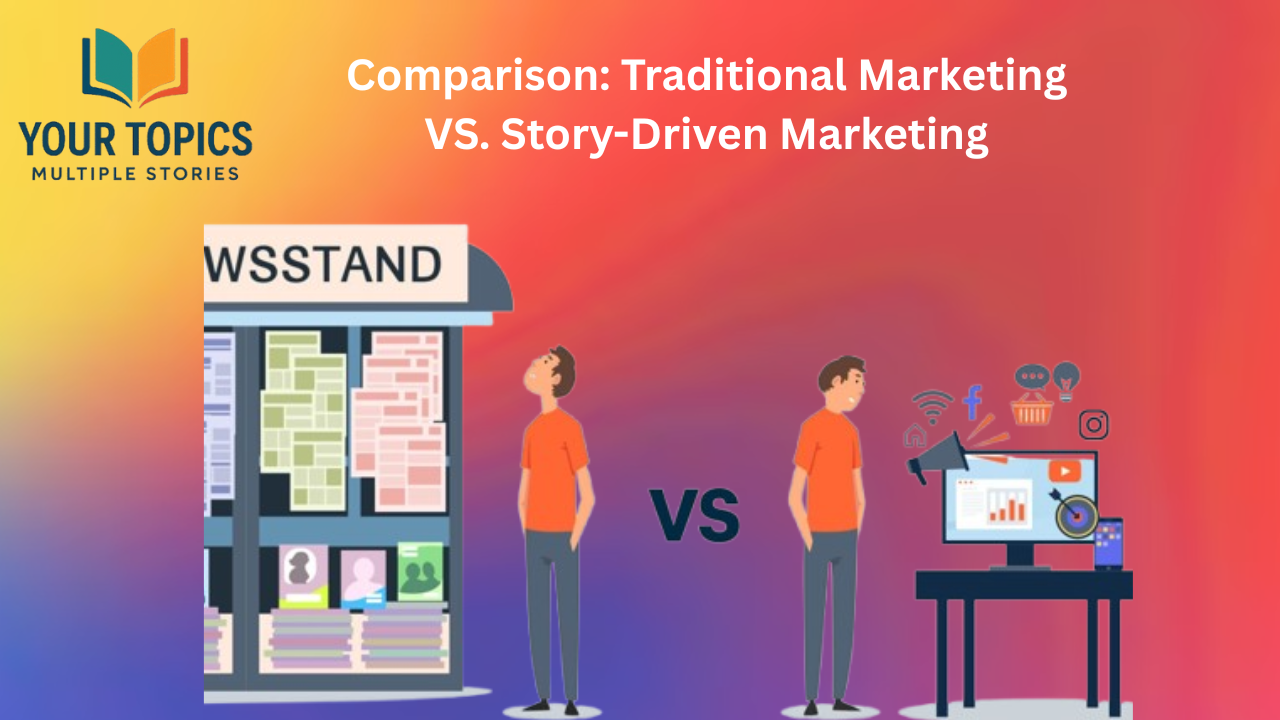
Example: Running Shoe Advertisement
“Our new running shoe features triple-density foam cushioning, breathable mesh upper, and our patented stability technology. Available in 12 colors. $129.99.”This tells you what the product is but creates no emotional connection or memorable impression.
Story-Driven Approach: Experience-Focused
Example: Running Shoe Advertisement
“Mile 18 of the Chicago Marathon. Sarah’s legs are screaming. The wall everyone warned her about isn’t a metaphor anymore—it’s real. But with each step, she feels something: cushioning that adapts, support that responds, lightness that propels. She’s not just running in shoes; she’s running in confidence. Three miles later, she crosses the finish line, arms raised, tears streaming. Her first marathon. Not her last.”
Same product. Completely different impact. The second version lets potential buyers imagine themselves in Sarah’s shoes—literally and figuratively.
Key Differences
Traditional Marketing:
- Focuses on product specifications
- Uses company-centric language
- Appeals primarily to logic
- Forgettable and interchangeable
- Creates awareness without connection
Story-Driven Marketing:
- Focuses on customer transformation
- Uses emotional, relatable language
- Appeals to identity and aspiration
- Memorable and distinctive
- Creates connection that drives action
How to Craft Your Own Business Storytelling Examples
Start With Authentic Experience
The most compelling stories come from real experiences, not creative brainstorming sessions. Interview customers about their challenges before finding you and their transformations after. Document employee experiences navigating company changes. Record your own journey building the business.These authentic narratives provide raw material far more powerful than anything you could fabricate.
Follow the Universal Story Arc
Every effective story contains these elements:
Character: Your customer, employee, or company faces a situation Challenge: An obstacle, problem, or opportunity appears Choice: Decisions must be made with uncertain outcomes Consequence: Actions lead to results—positive or negative Change: The character transforms through the experience
This structure feels natural because it mirrors how we experience life. Apply it to case studies, sales presentations, founder stories, and marketing campaigns.
Make It Specific and Sensory
Weak: “Our client improved their operations.”Strong: “At 7:30 AM, David walked into a warehouse where three employees were arguing over a missing shipment while two others manually searched through boxes. Six months later, that same warehouse runs like a Swiss watch—every package tracked, every employee equipped with real-time data, every customer receiving updates automatically.”Specific details make stories vivid and believable. Generic claims sound like marketing copy.
Address Objections Through Story
Rather than listing rebuttals to common objections, tell stories that demonstrate solutions. If prospects worry about implementation difficulty, share a story about your most technologically challenged customer who got up and running in days.Stories dissolve skepticism more effectively than arguments ever could.
Frequently Asked Questions
What makes a good business storytelling example?
A good business storytelling example combines authenticity, relatability, and clear transformation. It features real challenges that your audience faces, demonstrates how those challenges were overcome, and shows tangible results. The best business narratives make listeners see themselves in the story and believe similar transformation is possible for them.
How is storytelling used in business communication?
Storytelling in business communication serves multiple purposes: simplifying complex concepts, making data memorable, building emotional connections with audiences, and inspiring action. Leaders use stories in presentations, sales teams use them to demonstrate value, marketing teams use them to build brands, and HR departments use them for culture-building and change management.
Can small businesses benefit from corporate storytelling?
Absolutely. Small businesses often have advantages in storytelling because their founders and customers are more accessible. A local bakery can share daily stories about ingredients, customers, and community impact. A startup can document its journey transparently. Authenticity and relatability matter more than production budgets.
What’s the difference between business storytelling and lying?
Business storytelling is based on real experiences, genuine challenges, and authentic transformations. Lying involves fabrication and deception. Good storytelling selects and frames true events to highlight particular lessons or values. It may simplify complex situations for clarity, but the core facts remain accurate and verifiable.
How do you measure the ROI of business storytelling?
Measure storytelling effectiveness through engagement metrics (time on page, video completion rates, shares), conversion rates (how story-driven content performs versus traditional marketing), brand sentiment (surveys and social listening), and ultimately sales impact (tracking which customers were influenced by specific narrative campaigns). Customer retention and employee engagement also improve with effective storytelling.
Implementing Business Storytelling in Your Organization
Creating a storytelling culture doesn’t happen overnight, but you can start with these practical steps:
Create a Story Library
Systematically collect customer success stories, employee experiences, and company milestones. Interview team members about memorable moments. Document challenges and how they were overcome. This library becomes your raw material for future campaigns, presentations, and communications.
Train Your Team
Sales teams, customer service representatives, and leaders all benefit from storytelling training. Teach them the basic story arc structure. Practice converting features into customer-centric narratives. Role-play presentations that use stories instead of bullet points.
Make Story Collection Part of Your Process
Build story collection into your customer onboarding, quarterly reviews, and project debriefs. When someone mentions a great result or interesting challenge, immediately schedule a 15-minute interview to capture the full story while details are fresh.
Test and Iterate
Not every story will resonate equally. Test different narratives in your marketing, track which stories prospects respond to in sales conversations, and note which internal stories motivate team action. Double down on what works and refine what doesn’t.
The Competitive Advantage of Business Narrative Examples
In saturated markets where products become increasingly similar, your story becomes your sustainable competitive advantage. Competitors can copy features, match pricing, and replicate distribution. They cannot copy your authentic narrative—your unique history, your specific customer transformations, your particular perspective and values.
The businesses that will dominate the next decade won’t be those with marginally better products. They’ll be those who can articulate a compelling reason why they exist, demonstrate how they transform customers’ lives, and invite people into a narrative larger than a transaction.
Your product is what you sell. Your story is why people buy. Master business storytelling, and you’ll build something far more valuable than a customer base—you’ll build a community of believers who advocate for your brand because they see their own story reflected in yours.
The examples we’ve explored—from Nike’s inspiration to Airbnb’s belonging, from Warby Parker’s rebellion to Patagonia’s activism—prove that storytelling isn’t optional marketing fluff. It’s the strategic foundation of business communication that drives growth, builds loyalty, and creates lasting competitive advantage.
Start collecting your stories today. Your next customer is already looking for a narrative they can believe in. Make sure they find yours.