Leadership and Management Skills: Your Complete Guide to Building Teams That Actually Deliver

Leadership and management skills are no longer optional nice-to-haves in today’s workplace—they’re the difference between teams that thrive and teams that barely survive. I’ve watched countless talented professionals get promoted into leadership roles only to struggle because nobody taught them how to actually lead people while managing results.
If you’re reading this, you probably fall into one of these camps: you’re a new manager feeling overwhelmed, an experienced leader looking to sharpen your edge, or someone eyeing that next promotion who knows you need to level up. The good news? Leadership isn’t some mystical gift you’re born with. It’s a learnable craft, and I’m going to show you exactly what matters in 2025.
Why Most Leadership Training Fails (And What Actually Works)
Here’s the uncomfortable truth: most leadership development programs teach theory while your team needs you to solve real problems today. You sit through workshops about “vision casting” while your best performer just handed in their resignation. You learn communication frameworks while your remote team struggles with basic accountability.
The gap between traditional management training and modern workplace reality has never been wider. That’s why we’re taking a different approach—one grounded in what actually moves the needle when you’re leading real humans through real challenges.
The Foundation: Essential Leadership Skills for Managers
Before we dive deep, let’s establish the non-negotiables. These are the essential leadership skills for managers that separate mediocre bosses from leaders people actually want to follow.Emotional Intelligence in Action
You’ve heard about emotional intelligence a thousand times, but here’s what it looks like when the pressure’s on: Your star developer just missed a critical deadline. A manager with low EQ sends a passive-aggressive email. A leader with high EQ recognizes the missed deadline as a symptom, not the disease, and has a real conversation to understand what’s happening beneath the surface.
Emotional intelligence means reading the room when your team’s energy is off. It means knowing when to push and when to back off. It means managing your own stress so it doesn’t cascade down to everyone else.Decision-Making Under Uncertainty
Nobody prepares you for this: you’ll make consequential decisions with incomplete information while everyone watches. That’s not a bug in your leadership journey—it’s the entire job description. The management skills every leader needs include developing a decision-making framework that works when things get messy.
I’ve seen leaders paralyzed by perfectionism, waiting for more data that never comes. Meanwhile, their competitors act, learn, and adapt. Your job isn’t to make perfect decisions. It’s to make timely decisions, own them, and adjust course when reality gives you new information.
Communication That Actually Lands
Here’s where most leaders lose their teams: they communicate constantly but nobody understands what they’re actually saying. You send detailed emails that people skim. You hold meetings where everyone nods but nothing changes afterward.
Effective communication means saying less but making it count. It means repeating your key messages in different ways until they stick. It means checking for understanding, not just broadcasting information. When you’re managing remote teams, this skill becomes even more critical—you can’t rely on casual hallway conversations to fill in the gaps.
Modern Leadership and Management Techniques That Drive Results
The workplace has fundamentally changed, and your leadership approach needs to change with it. Let’s talk about what actually works in 2025.
Leading Hybrid and Remote Teams
Leadership and management skills in remote teams require a complete mindset shift. You can’t manage by walking around when your team is scattered across time zones. You can’t read body language through Slack messages.
What works:
- Overcommunicate context, not just tasks: Remote workers need to understand the “why” behind their work because they can’t absorb it through proximity
- Create intentional connection moments: Your team won’t bond accidentally anymore. Schedule virtual coffee chats, celebrate wins publicly, make space for non-work conversation
- Document everything: When someone’s always asleep during your meetings, comprehensive documentation becomes your leadership superpower
- Measure outcomes, not activity: Nobody cares if your remote developer is online at 9 AM sharp if they’re shipping exceptional code
The leaders who excel at remote management understand that trust scales better than surveillance. They build systems that enable autonomy while maintaining accountability.
Transformational Leadership Skills for Complex Challenges
Transformational leadership isn’t about being charismatic—it’s about fundamentally changing how your team thinks about what’s possible. When I work with transformational leaders, I notice they share three core practices:
They challenge the status quo without burning the house down. They ask “why do we do it this way?” more than they say “here’s how we’ve always done it.” But they also respect that some established processes exist for good reasons.
They develop people beyond their current roles. The best leaders I know are constantly stretching their team members, giving them challenges slightly beyond their comfort zone, then supporting them through the struggle.
They align individual purpose with organizational goals. People don’t quit jobs—they quit feeling like their work doesn’t matter. Transformational leaders help every team member see how their contribution connects to something bigger.
Strategic Leadership vs Managerial Skills: Understanding the Balance
Here’s where many leaders get stuck: they over-index on either strategy or execution, when great leadership requires both.
Strategic Leadership means zooming out. It’s about:
- Seeing around corners and anticipating market shifts before they hit
- Allocating resources toward future opportunities, not just current fires
- Building organizational capabilities that will matter in three years
- Making strategic bets even when the data isn’t conclusive
Managerial Skills means zooming in. It’s about:
- Ensuring your team has clear priorities and removes blockers
- Monitoring progress and addressing performance issues quickly
- Managing budgets, timelines, and stakeholder expectations
- Creating processes that scale as your team grows
Most leaders naturally gravitate toward one or the other based on their personality. The strategic thinkers love vision boards but their teams struggle with execution chaos. The execution-focused managers run tight ships but miss strategic opportunities.
The sweet spot? Develop both. Spend Monday mornings on strategy. Spend Tuesday through Thursday in execution mode. Spend Friday reflecting on what you learned and adjusting course.
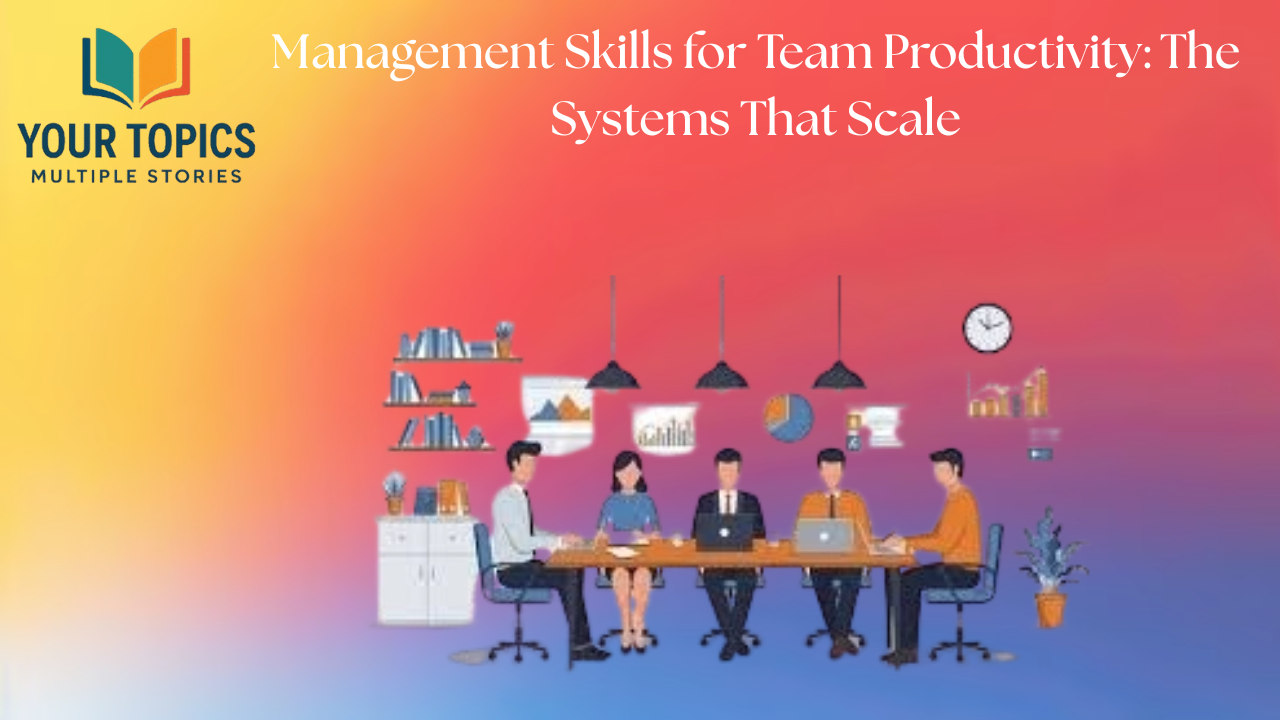
Management Skills for Team Productivity: The Systems That Scale
Let me share something most leadership books won’t tell you: your job isn’t to maximize productivity—it’s to create an environment where productivity happens naturally.
The Productivity Fundamentals:
- Clarity beats motivation every time. Your team can’t be productive if they’re confused about priorities. When everything’s important, nothing is. I recommend the “One Thing” framework: if your team could only accomplish one thing this quarter, what would create the most value?
- Remove friction relentlessly. Every unnecessary approval, every poorly designed tool, every pointless meeting—these are productivity killers hiding in plain sight. Walk through your team’s workflow and ask: “What makes their job harder than it needs to be?”
- Protect deep work time. The modern workplace is designed for distraction. Your job as a leader is to create boundaries that allow focused work. Some teams do “No Meeting Wednesdays.” Others have “Maker Mornings” where interruptions are off-limits. Find what works, then defend it fiercely.
- Measure what matters, ignore the rest. If you’re tracking 47 different KPIs, you’re not actually tracking anything. Identify the 3-5 metrics that truly indicate progress, then build transparency around them.
Leadership Skills for Startup Founders: Playing Without a Playbook
Startup leadership is its own beast. You’re building the plane while flying it. You’re doing ten jobs simultaneously. You’re making million-dollar decisions with thousand-dollar information.The leadership skills for startup founders that matter most:
Rapid context switching: You’re in an investor pitch at 10 AM, a technical architecture review at 11 AM, and handling an HR issue at noon. Your brain needs to shift gears without grinding.
Comfortable with ambiguity: There’s no manual for your specific situation. You’ll figure it out by doing, failing, learning, and iterating.
Resourcefulness over resources: Big companies solve problems by throwing money at them. Startups solve problems by being creative with constraints.
Knowing when to do versus delegate: Early on, you’ll do everything. As you grow, knowing what only you can do versus what others should do becomes critical.
Essential Leadership Competencies Comparison
Let me break down how different leadership approaches compare in real workplace scenarios:
| Situation | Traditional Management | Modern Leadership | Outcome Difference |
| Employee misses deadline | Focus on the mistake, demand explanation | Understand root cause, solve systemic issue | First creates fear, second builds trust |
| Team conflict | Mandate resolution, separate people | Coach through conflict, teach resolution skills | First suppresses, second develops capability |
| Strategic pivot needed | Top-down directive | Collaborative sensemaking | First gets compliance, second gets buy-in |
| High performer struggling | Performance improvement plan | Career development conversation | First loses talent, second retains it |
The pattern? Traditional management treats symptoms. Modern leadership addresses root causes while developing people.
Frequently Asked Questions About Leadership and Management Skills
What’s the difference between leadership and management?
Management is about processes, systems, and predictable outcomes. Leadership is about people, vision, and navigating uncertainty. You need both. Manage the work, lead the people.
Can you develop leadership skills, or are leaders born?
This question drives me crazy because it keeps capable people from stepping up. Yes, some personality traits make leadership easier. But the essential leadership skills for managers—decision-making, communication, strategic thinking—are absolutely learnable. I’ve seen introverted, analytical people become exceptional leaders by playing to their strengths.
How long does it take to develop strong leadership skills?
Real talk? You’ll be learning until you retire. That said, you can see meaningful progress in 6-12 months with deliberate practice. The key word is “deliberate”—you need feedback, reflection, and intentional skill development, not just time in a leadership role.
What are the most important management skills for team productivity?
Priority-setting, clear communication, removing blockers, and creating psychological safety. If your team doesn’t feel safe to speak up, share concerns, or admit mistakes, productivity will always be limited by fear.
How do leadership and management skills differ for remote teams?
Remote leadership requires explicit what used to be implicit. You need stronger written communication, more intentional relationship-building, and better documentation. You also need to trust more and micromanage less—because you simply can’t watch people work.
What leadership development programs actually work?
The best programs combine three elements: structured learning (frameworks and concepts), real-world application (you try things with your actual team), and peer learning (you discuss challenges with other leaders). Avoid programs that are all theory with no practice.
Your Leadership Development Roadmap for 2025
Here’s how to actually improve your leadership and management skills in the next 90 days:

Weeks 1-4: Self-Assessment and Feedback Get clear on where you actually stand. Ask your team for feedback (anonymously if needed). What’s working? What’s not? Where are you creating unnecessary friction?
Weeks 5-8: Skill Development Pick one skill from this article that would create the biggest impact. Not ten skills—one. Read about it, practice it, get feedback on it, refine your approach.
Weeks 9-12: System Building Take what you’ve learned and build it into a system. If you improved at giving feedback, create a regular feedback cadence. If you got better at prioritization, implement a weekly planning process.
The leaders who level up fastest aren’t the ones who try to improve everything at once. They’re the ones who improve one thing deeply, make it stick, then move to the next thing.
The Bottom Line
Leadership and management skills aren’t separate from your work—they are your work. Every conversation is leadership. Every decision is management. Every moment you’re either building or eroding trust with your team.
The 2025 workforce doesn’t want bosses who bark orders. They want leaders who remove obstacles, provide context, and help them do the best work of their careers. They want managers who can operate strategically while executing flawlessly. They want someone who sees them as humans, not resources.
You don’t need to be perfect. You need to be growing. Start with one skill from this guide. Practice it until it becomes natural. Then move to the next one. That’s how you build leadership and management skills that actually matter—one intentional decision at a time.
Your team is watching. Not to judge, but to follow. Where are you leading them?